
Patrick Bateman Selects His Favourite Madonna Album on its 40th Birthday
Friday is fun because it's music day, so there's a playlist. And lots of tunes. And today another special guest post by the one and only Patrick Bateman...lucky!

While I would never begrudge a person from checking in on 1983’s self-titled album, Madonna (I sure love that opening cut, Lucky Star), I could also understand if you didn’t. And the all-around improvements felt a year later with Nile Rodgers giving his clipped funk-pop production nods to Like A Virgin — and its title track, Material Girl, suggested something was actually happening. And if, like me, after seeing Desperately Seeking Susan, you imported the European 1985 reissue to have Into The Groove on an album with other Madonna pop gems, you were probably hoping on some level to really be nicely surprised with the third album.
And it really is 1986’s True Blue where Madonna Louise Ciccone, known mononymously as Madonna, actually finds herself well and truly into the groove!
The album, a bubbling cauldron of synths with some strings attached (actual string-section sequences, although probably cued by the synthesisers in a lot of cases) was a conscious ditching of the “Minnie Mouse” vocal stylings that had her written off as purely bubblegum. Here Ms. Ciccone was in her lower register, and comfortable, in fact devastatingly so on Live To Tell. She was also the co-composer of practically every song here. And the co-producer.
Madonna got a lot of grief for being a pin-up rather than producer, and she laughed all the way to the bank of course. But also there she was, doing the work.
Live To Tell was an instrumental for a film, until Madonna heard it and attached her words. Its beautiful, instrumental storytelling is one thing, but it lives (to tell) and breathes (to exist) because of her vocal effort, and the drama she sells within the lyric.
Papa Don’t Preach was written for someone else entirely. It was a fully formed demo when Madonna heard it. Her lyric contribution might have been negligible if you are not being charitable, but it was her chance to step up and sell the drama of a song — something she became almost instantly very good at doing; it’s just that prior to this she was gonna “dress you up in my love” or she was reworking the Marilyn Monroe tropes and types for Material Girl’s look.
On True Blue, and in songs like Live and Papa we have first real indication of Mads doing it for herself as much as for her audience. She wants to tell stories. She wants to sell stories as much as she wants to sell records.
True Blue lets her do both.
And it remains the best-selling album of the 1980s by a female artist, and the best-selling album of her career.
Now, sure, I like other Madonna albums, like the much later Ray of Light from the late 90s. Evelyn tells me that’s actually Madonna’s best album, which only reminds me to never call her back!
If we could count I’m Breathless — a sort of parallel soundtrack to Dick Tracy — and the ‘Vogue’ era in general then I’m going to plump for that. For sure. But really, True Blue is the defining Madonna album. And without it there wouldn’t be the continuation of her career. (Which is what I did say to Evelyn in a perfectly timed voice-note). True Blue is the set of songs that lets us appreciate Madonna as an Album Artist. Something we weren’t used to doing with female pop acts, unless they were named Kate Bush.
It’s also the way an artist was built forty years ago: First album has a hit, enough for people to care, second album is an improvement — but essentially a sequel, the same ideas realised once again, and with just enough extra so that there were a few new fans on board, and no one that caught the train the first time around decided it was time to get off. And then — Wham! (if you’ll pardon the pun/reference to another pop act of the time) — third album is where the consolidation and artistic development party with each other in sophistication.
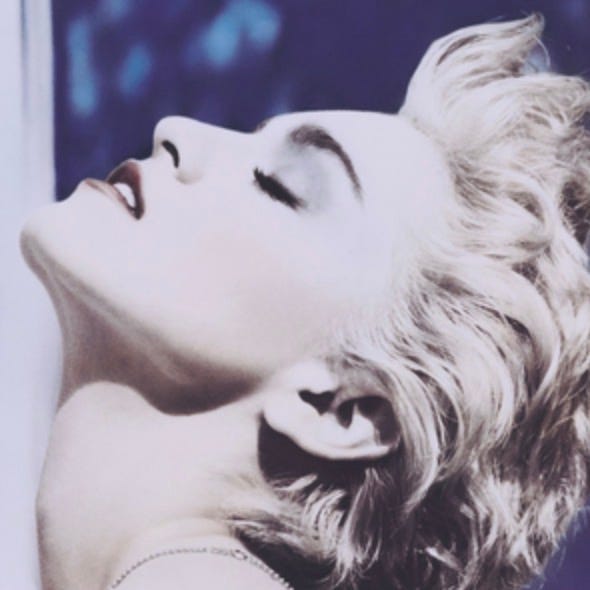
Just look at that cover shot by the veteran Herb Ritts. His subversion of the Andy Warhol archetype builds on the overt sex appeal that was helping to sell Madonna at the time, but shows a new, mature approach to the Material Girl.
Alabaster skin to match the vital minerals within this music. And speaking of mining… this is a woman with better, deeper material now.
And it’s all there in that cover shot. And certainly in the opening strains of Papa Don’t Preach, a song about a teen pregnancy, which is not based on Madonna’s own experience at all, but she’s going to sell you on that drama still!
If Papa Don’t Preach is the serious opener, and we definitely get that lower register of voice — it works to sell the drama — then Open Your Heart is the slice of pop confection to show there’s still a party.
Open Your Heart is the Madonna of 1986 reworking her earliest (1982-1985) material in this sharper package. Slick, and primed, and smart.
Live To Tell is the emotional centre of the album — it’s also the enduring proof to me that Madonna was an excellent writer:
A man can tell a thousand lies
I've learned my lesson well
Hope I live to tell
The secret I have learned, 'til then
It will burn inside of me
is almost a riddle — it’s almost meaningless on the page, but it contains the truth of the universe when it comes out of Madonna’s mouth. Which is the beginning of the enduring proof that Madonna was capable of being an excellent singer. Paul Allen disagrees with me. But Paul Allen wears brown shoes!
The title track gets to where Michael Jackson wanted to be with The Way You Make Me Feel. Madonna just makes us feel that way a whole year earlier.
But the real mark of sophistication on this record is La Isla Bonita. I’m a big fan of Material Girl-Madonna, but it’s the indulgence of Latin pop fills that properly introduces Madonna to several different subcultures that will make up her core audience. And it’s just a smoke show of a song!
The Madonna of True Blue and of the videos for True Blue, such as La Isla Bonita, is the Madonna of several movie projects, remember. She has completed Desperately Seeking Susan, she has made Shanghai Surprise, and Who’s That Girl? is very much on the table. She has met and married Sean Penn, and written the song True Blue for him. Or about him. About how he made her feel. Which might seem comical now, but in 1986 America they were the ideal pop/film couple. He was the bad boy that could act, and could be tamed just enough by the pop princess. She was the mainstream musical act who apparently couldn’t act, but with ambition for the movies — and for almost everything. And it wasn’t that she was the good girl to his bad boy, but she was definitely playing some sort of role. If her abilities as an actress on the screen weren’t being met with acclaim, they were better realised in the music videos she was making; Madonna was adept at playing roles, remaking and remodelling herself within songs and for the promotional clips to sell the songs.

There are other songs on the album that were much smaller — White Heat, Where’s The Party, Jimmy Jimmy, Love Makes The World Go Round, but they provide the breathing space for the huge hits to continue the party.
After True Blue, Def Leppard (Hysteria), INXS (Kick), and Michael Jackson (Bad) would go too big, often — too much, too maximalist. Before True Blue, you had examples of huge albums like Prince’s Purple Rain and Michael Jackson’s Thriller, and these were the types of albums Madonna studied. In fact she’s more of a Prince devotee than anything, and True Blue isn’t exactly her Purple Rain, for it lacks the film role and actual signature film to stand behind, but it lines up in a similar fashion of hits to album tracks ratio, of everything moving in the right direction — and of course the conscious rebirth; the artist leaving behind a squeakier, smaller persona, and stepping up so fully into adult pop clothes. Not just cosplay.
True Blue has a handful of Madonna’s biggest hits, and though she would make more great songs, she wouldn’t make a better album. At least not for over a decade.
What she would do here that is also important is solidify the relationships. Co-producer and songwriter Patrick Leonard would stay with her from this album all the way up to and including Ray of Light. Stephen Bray, the other co-producer and writer, was also her drummer and former boyfriend. He had worked with her before, most notably co-writing Into The Groove, and he would stay on for while after, helping to make Express Yourself. But these two writers would be Madonna’s most stable and successful collaborators. They helped her transition from a pop act for teens and tweens to the adult world of pure pop in a radio sense.
True Blue gets my vote for the Madonna album to put in the Smithsonian. The one we play to the aliens to not only placate them, but to explain the very ideal of the 1980s pop act.

And it’s about to turn 40. Next week. So give it a listen if you never tried all the way through. Or listen again if it’s been a while — it is more than just Live To Tell and Papa Don’t Preach. More than the title song and La Isla Bonita. More than Open Your Heart too.
It is 1986. It is everything that burst overground that year. That is the style and spirit of that time. And forty years on it maintains both its innocence and its extravagance. It is the coy person at the party. And the extrovert too. It is rampant commercial pop music. And yet it has a heart. Somewhere in there, in those perfectly written-to-formula pop songs that repeat themselves until they imprint on your brain there beats the stuff of a lion. There sits the perfect set of tunes for then, for now, for always.
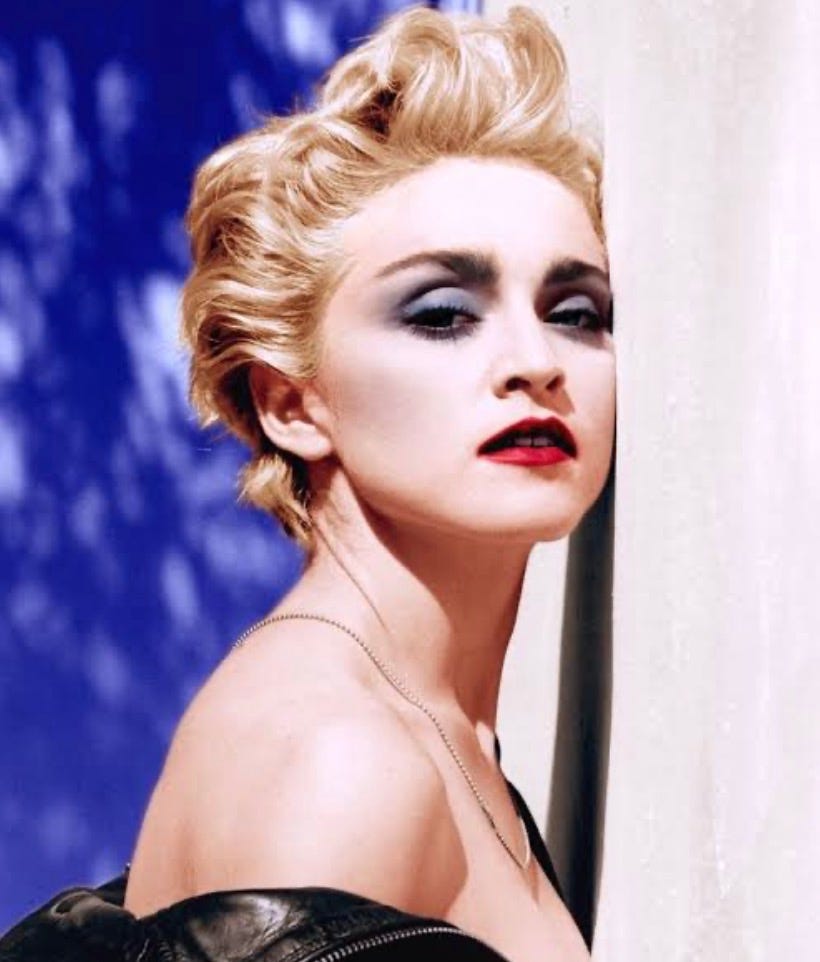
And it’s Friday, so you get a playlist — this one’s a wee ripper!
Patrick Bateman Reviews "Dire Straits"

The album Dire Straits, the debut by British band Dire Straits was recorded in London in February, 1978. It might as well have been recorded in a bubble.