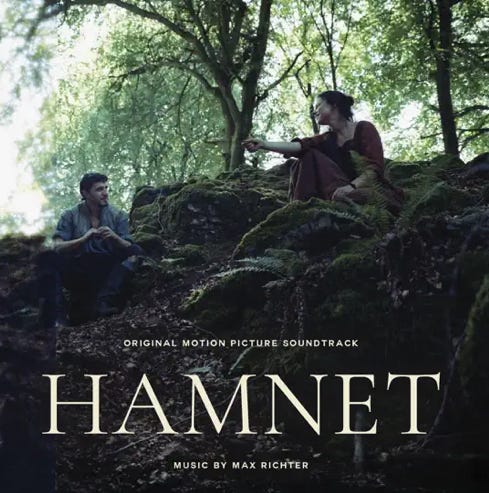
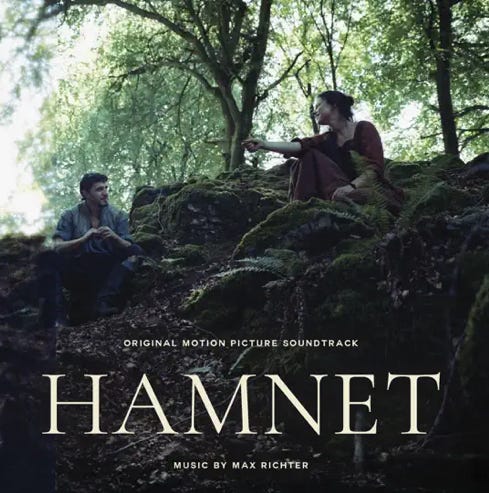
Max Richter: Hamnet (Original Motion Picture Soundtrack)
An album review of Max Richter’s subtle and sublime work providing score for the movie, Hamnet

Max Richter
Hamnet (Original Motion Picture Soundtrack)
A Decca Records Release, under exclusive license to Universal Music Operations Limited
When the film Hamnet was announced (and don’t watch its trailer, it gives the whole timeline and story in microcosm) it felt like pure bait for awards season. Grief. Trauma. Legacy. Famous play, new twist/backstory, based on a novel. And great actors in the lead. A strong directing hand, and the filmmaker (Chloé Zhao)returning to the style she’s better known for (Nomadland) after earning some bucks doing Marvel (Eternals).
I wasn’t convinced I needed to see it.
I’m glad I did though — it’s a truly excellent film with wonderful performances. And it’ll earn its awards and nominations most thoroughly.
The thing that turned me around was the promise of Max Richter’s score.
I listened to it before seeing the film. And I was instantly given another reason to see the film, beyond the promise of Jessie Buckley’s performance (which is like nothing else you’ll see this awards season).
Richter, a contemporary classical composer and performer who has some background in film and TV composition (Waltz with Bashir, The Leftovers) feels thematically linked to this work — his own efforts a kind of ‘version’ of classical in the way that this story is a version of Shakespeare; meant as no disrespect to either — more a case of Richter’s music help inform Zhao‘s film to trace around the look and feel (and sound) of what might be true and real, all the while gathering the stardust of its own magical realism and impressionistic traces.

The early cues here are subtle, and help support the early storyline which looks at Agnes (“Anne”) and the connection she has with the spirit world and nature (Of Agnes). Voice and strings are mercurial in their arrangements here, gentle and warm, never feeling shadowy or distanced. A real uplift and feeling of hope, which of course runs cleverly counter to a large part of the screenplay’s action and mood. But cleverly underpins the denouement — this isn’t a film about Shakespeare at all, this is a film about art and tragedy (both real life and the theatrical kind) and how they help foster human connection. So Richter’s involvement is key, his music has been making those moves across the last 20 years or so.
In that sense this feels similar to Zhao using the existing works of another classical composer (Ludovico Einaudi) for her film, Nomadland. That similar sort of uplift in the wake of depression; the sun through the curtains. The first peek at light.
And to that point, at first I thought it was a bit much having Richter’s composition, On The Nature of Daylight here. It’s been used by Max in many of his scores, and by so many film directors. The piece, majestic, is now 21 years old, and feels like an obvious go-to.
But of course it’s always beautiful to listen to, and it really is the show-stopping piece of this score when you hear it while seeing it. I believe the actor Jessie Buckley told Chloé Zhao that she should use it, sent her it, and they rewrote the way the penultimate scene and finale would play out to have this music as soundtrack for the events.
It’s a perfect bit of music for a perfect scene.
And elsewhere throughout the score we have moods gently building (Of Orpheus) and gorgeous use of very minimalist piano (See things that others don’t), and just the right use of electronics to list the organic instruments and hint, once again, at that level of magical realism that hovers in and round the script (An abysm of time).
I’ve loved listening to this in the buildup to, during, and now after the film. It’s that perfect slice of ambient-meets-classical that I am almost always looking for. And it’s some of Richter’s finest work to date, which, this late into his so fully established career is hopefully saying something.